
How to Start Online Coaching: Service, Process, and Checklist
Build an online coaching service for your first clients, with clear scope, capacity, onboarding, weekly delivery, and a PDF launch kit.
Online coaching starts with a precise service definition. Decide who you help, what you deliver regularly, what you need from the client, and where the service ends. You can then calculate capacity, build the delivery process, and onboard the first clients.
The EuropeActive standard for online fitness services includes onboarding, individual programming, progress tracking, feedback, communication, and the safety limits of remote delivery. An online service is more than a plan sent as a PDF. It is a repeatable way to make and communicate decisions.
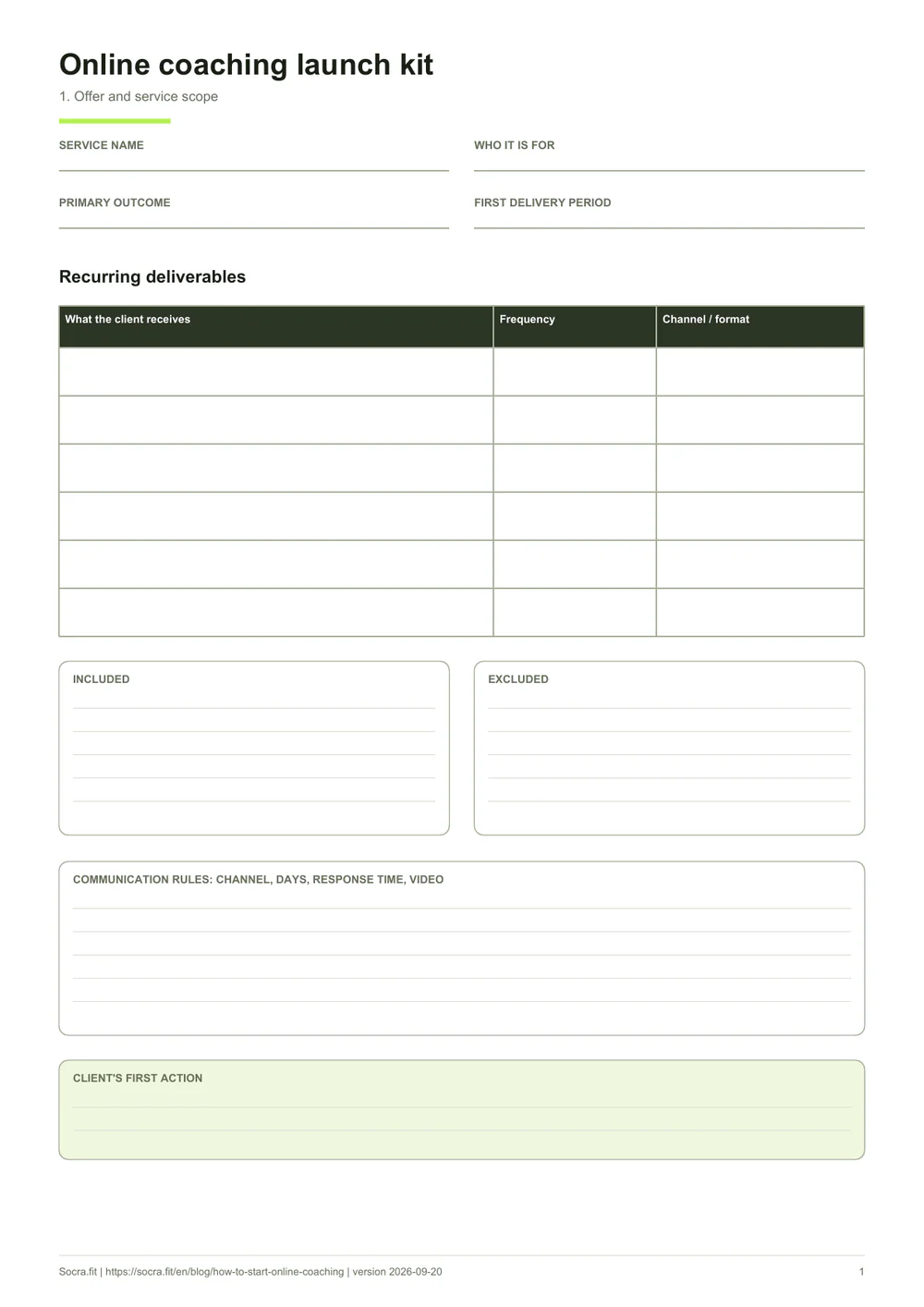
A launch kit for your first online clients
Four printable pages help you define the service, calculate capacity, prepare onboarding, and review a pilot.
Download the PDF launch kit1. Choose one client and one primary outcome
"Online coaching for everyone" is difficult to explain and deliver. Start with a group you already know how to coach within your qualifications. Describe a real situation rather than inventing a marketing persona.
A useful sentence contains three parts:
I help [who] achieve or manage [specific outcome or process] through [method of coaching], even when [common constraint].
Example: "I help adults who already know the basic lifts complete three useful weekly sessions through an individual plan, consistent logging, and weekly feedback, even when their work schedule changes."
This is a positioning example, not a promised result. It does not state how quickly someone will change or imply that the trainer provides healthcare.
2. Define what the service includes
The scope should make sense without a sales call. Separate regular deliverables, communication rules, and exclusions.
Regular deliverables
- an initial consultation and intake process
- an individual training plan for an agreed period
- a way to record completed sessions and effort
- a weekly or otherwise agreed check-in
- a regular review and any explained plan update
- technique feedback, if you genuinely provide it through a suitable process
Communication rules
- one primary channel for routine messages
- response days and an approximate response window
- the format for technique videos and the context the client should include
- what happens when the client stops responding
- what to do when equipment, schedule, or another practical constraint blocks the plan
Outside the service
State what you do not provide and what exceeds your qualifications. This may include diagnosis, treatment, rehabilitation, or individualized care reserved for another professional. Write the boundaries to match your qualifications and the requirements that apply where you work.
The EuropeActive personal trainer standard includes collaboration with or referral to another qualified professional when the client's needs exceed the trainer's scope. Remote delivery does not widen that scope.
3. Calculate time before client count
Capacity is the total of recurring weekly work, less frequent monthly work, new-client onboarding, and a realistic buffer. A client count without that workload model hides the expensive parts of the offer.
Build your own time model:
weekly time per active client
= training record review
+ check-in review
+ routine messages and feedback
+ allocated share of the four-week review and plan update
Fictional example: capacity in a four-week block
These figures are a fictional planning example, not a recommended service level.
- records and check-in review: 20 minutes per client per week
- routine messages: 10 minutes per client per week
- four-week review and plan update: 44 minutes per client per four-week block, equal to 11 minutes per week
- recurring total: about 41 minutes per active client per week
Twelve active clients require 492 minutes, or 8 hours and 12 minutes, of recurring work each week. Two new onboarding calls of 75 minutes during the same four-week block add an average of 37.5 minutes per week. Add a stated 90-minute weekly admin and disruption buffer, and the model totals 619.5 minutes, or about 10 hours and 20 minutes per week.
The online coaching profit calculator uses calendar-month averages, so its weekly and monthly conversions may differ from this deliberately simple four-week block. Enter your own workflow there rather than copying these assumptions.
4. Build onboarding that ends with an action
The client should not finish onboarding with a vague promise that a plan will arrive. They should know what is complete, what they still need to provide, and exactly when the service begins.
A minimum flow can be:
- the client receives the service description and books a consultation
- they complete intake information and any separate health screening
- you discuss the goal, schedule, experience, equipment, and constraints
- you confirm the service scope, communication rhythm, and next action
- the client receives the plan, logging instructions, and first check-in date
- after the first week, you verify that the process is clear
Use the personal training client onboarding guide for the full consultation agenda. Collect practical context with the client intake questionnaire and create recurring feedback with the online coaching check-in form.
5. Design the coach's weekly workflow
Online delivery becomes hard to manage when every client is reviewed differently. The system can be simple, but the order should repeat.
| When | Activity | Output |
|---|---|---|
| Ongoing | Client records completed and missed sessions, RPE, and necessary notes | Current training record |
| Agreed day | Client sends a short check-in | Context for the week |
| Coach review block | Coach reads exceptions, check-in, and open questions | One clear response |
| End of review period | Coach completes a combined review | Decision to keep or explain a plan change |
Track ongoing delivery in the personal trainer client tracker. Keep the plan in the personal training plan template, then use the monthly review process after the first complete period.
6. Design remote communication around what you cannot see
In an online service, you are not automatically present while the client trains. EuropeActive therefore includes suitable exercise environments, feedback, clear instruction, and the limits of remote supervision in its online standard.
For each deliverable, ask: what would I normally see during an in-person session that I do not have online? The missing information may concern the space, equipment, technique, or client response. Decide whether an instruction, video, live call, simpler option, or different mode of coaching is appropriate.
Do not imply continuous supervision when the service is asynchronous. The client should know when they are training independently and what to do if they are unsure.
Offer copy you can adapt
Copy and adapt
Online coaching is for [specific client] who wants to [outcome or process] and can train independently from agreed instructions.
The service includes an initial consultation, an individual training plan, regular session logging, a [frequency] check-in, feedback through [channel], and a plan review every [period]. I respond to routine messages during [days / response window].
The service does not include [clear exclusions]. If a need falls outside my qualifications or is not suitable for online coaching, I will say so and recommend an appropriate next step with a qualified professional.
The first step is [consultation / intake]. After that, we will both confirm whether this coaching format is suitable and when the first plan begins.
Keep only what you can deliver consistently. "Unlimited support" is vague. A named channel and response window gives the client something useful.
A welcome message for an accepted client
Copy and adapt
Hi, welcome to online coaching. Here is the plan for your first week:
- Complete the intake information by [date].
- Our consultation is [date and time] through [channel].
- You will receive the first plan on [date], together with logging instructions.
- Your first check-in is due on [date] through [location].
- I respond to routine messages during [response window]. If you are unsure about technique or the training conditions during an independent session, stop and contact me through our agreed process.
At the end of the first week, we will confirm that the plan and communication process are clear.
7. Run a small pilot and measure the operation
A pilot is a defined delivery period with a clear service scope. It lets you verify whether the process works for both client and coach before increasing capacity.
During the pilot, record:
- actual time spent on onboarding, check-ins, messages, and plan updates
- questions clients repeatedly ask
- places where instructions or responsibilities are unclear
- how many scheduled sessions came due and how they were recorded
- whether both sides follow the agreed communication rhythm
At the end, decide what to keep, shorten, explain earlier, or remove. A service that is already hard to deliver will not become easier simply because more clients buy it.
Checklist before the first client
- one sentence defining the client and service outcome
- regular deliverables and explicit boundaries
- a capacity model with a named buffer
- consultation and intake process
- a method for writing and delivering the plan
- a place for training records
- check-in questions and response timing
- a monthly review process
- rules for messages, videos, and situations unsuitable for remote delivery
- a process for changing or ending the service
Test your assumptions in the capacity calculator, and onboard the first client when you can describe an ordinary week of delivery. The tool can organize the work. The service depends on a clear agreement and consistent decisions from actual client records.