
Personal Training Client Onboarding: Consultation and Checklist
A practical first consultation process for personal trainers, with questions, service boundaries, a worked example, and a PDF checklist.
A useful first consultation produces more than a list of goals. By the end, you should understand who the plan is for, what the client can realistically do, where your professional scope ends, and how the service will work during an ordinary week. The client should leave with the same clarity.
The EuropeActive personal trainer standard connects consultation with health screening, appropriate assessment, agreed goals, and ongoing program review. NSCA describes the initial interview as a mutual check of fit, goals, and expectations. In practice, the consultation is a two-way working session, not an interrogation or sales monologue.
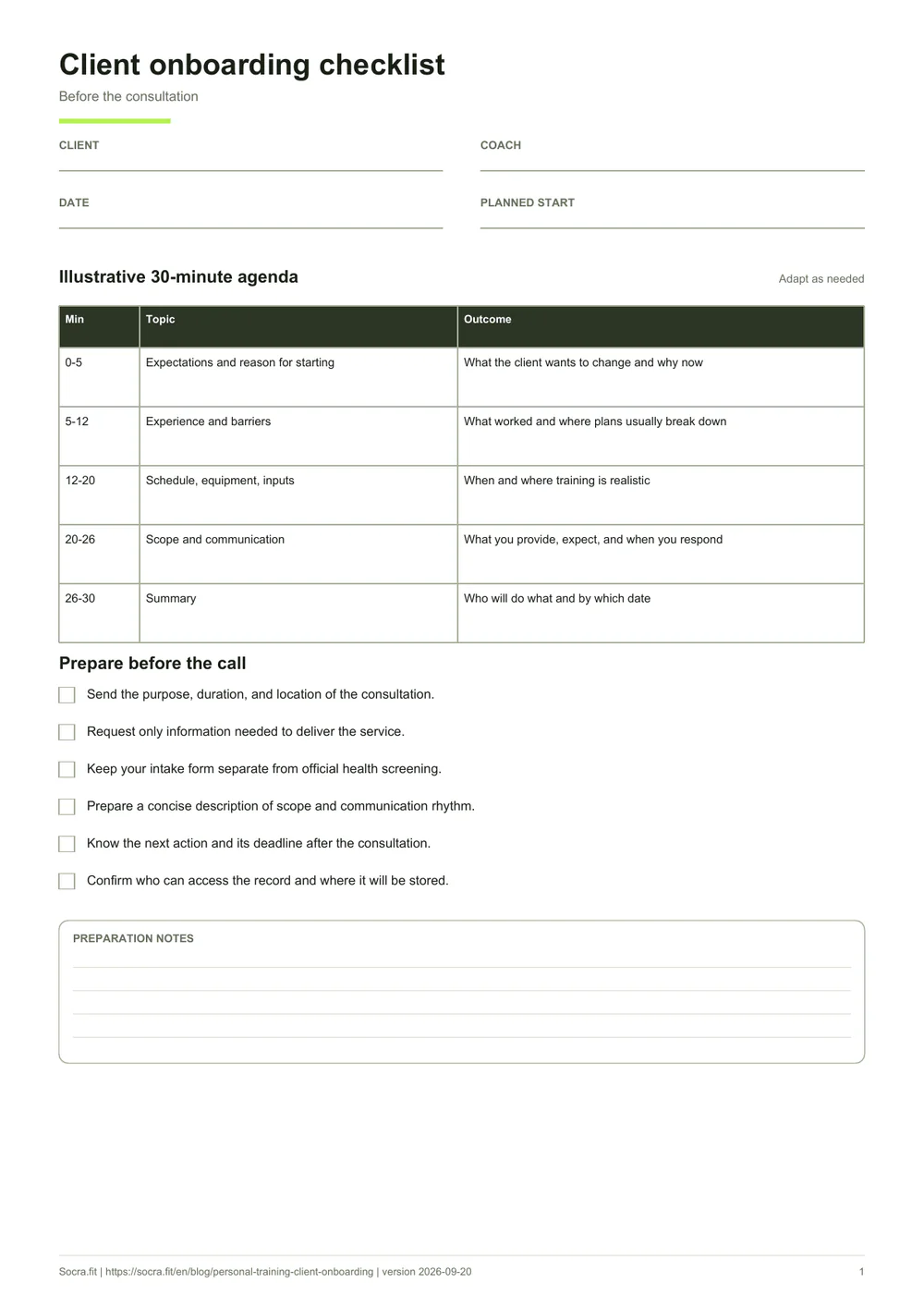
A checklist to use during the consultation
Three printable pages cover preparation, the conversation, and the follow-up.
Download the PDF checklistWhat to prepare before the consultation
Send a short message that explains what the call will cover, how much time to reserve, and what the client should complete first. You will spend less of the consultation copying basic details and more time understanding how those details connect.
You can collect core information with the client intake questionnaire. It is a custom, unvalidated template for gathering context. It is not the official PAR-Q+ and does not replace health screening.
If you use PAR-Q+, link to the current official version. Its publishers state that the form must remain unaltered and must not be incorporated into derivative questionnaires without permission. Follow the official pathway and keep any follow-up within your qualifications.
Before collecting personal information, decide why you need it, who can access it, and how long you will keep it. The GDPR guide for personal trainers provides a practical starting point, and the GDPR consent generator can produce an editable draft. The generated document is a template, not legal review of your particular practice.
Prepare five things before the call:
- the client's intake answers
- a concise description of your service and its scope
- questions about goals, experience, time, and barriers
- the system used to record plans, sessions, and feedback
- one clear next step after the consultation
An illustrative 30-minute agenda
Thirty minutes is an example, not a required duration. Extend it when your service or the client's needs call for more time.
| Time | Topic | What should be clear afterward |
|---|---|---|
| 0 to 5 minutes | expectations and reason for starting | what the client wants to change and why now |
| 5 to 12 minutes | experience and barriers | what they tried, what worked, and where plans usually break down |
| 12 to 20 minutes | schedule, equipment, and remaining inputs | when and where training is realistic and what information is still missing |
| 20 to 26 minutes | service scope and communication | what you provide, what the client provides, and when you respond |
| 26 to 30 minutes | summary and next action | who will do what, and by which date |
How to run the first consultation
1. Start with expectations, not measurements
A useful opening question is: "What would tell you three months from now that this coaching is working?" It gets you to the outcome the client actually wants. You can then define how you might observe progress and what is realistic during that period.
Separate the wish, the observable outcome, and the supporting behavior. "I want to feel better" is a valid wish. It needs an operational form, such as completing three scheduled sessions most weeks without the plan disrupting work. Not every goal needs to become a laboratory metric.
2. Map the client's past experience
Ask what the client did before, what they liked, and what made them stop. A previous plan is not a character test. It contains information about environment, motivation, skills, and barriers.
Useful questions include:
- What did you enjoy about previous training?
- What usually happened in a week when training fell away?
- Which exercises are familiar, and where do you need more instruction?
- Do you prefer training independently or at a scheduled time?
- What should this new plan avoid taking away from you?
That last question often reveals a real design constraint. The client may want to train without giving up a family evening or weekend sport. That does not mean they are unwilling to work.
3. Turn the calendar into a plan
"Three times per week" is not yet a schedule. Ask about specific days, available equipment, realistic session length, travel, and a backup option. If three gym visits work during an ideal week but none work during travel, agree in advance on what a workable travel week looks like.
Record the communication rhythm too. When does the client send a check-in? When do you respond? Where should technique videos go, and where should urgent scheduling messages go? A clear system removes small recurring decisions. You can start with the online coaching check-in form.
4. Separate information from clinical judgment
Health history, pain, medication, or pregnancy may change the next step. A trainer should not turn an intake answer into a diagnosis. EuropeActive explicitly includes referral or collaboration with another qualified professional when a client's needs exceed the trainer's scope.
A direct response is: "This is outside the area in which I can advise you safely. Before I complete the plan, I need you to discuss the next step with the appropriate qualified healthcare professional." It does not diagnose the issue or prescribe treatment. It simply names the boundary.
5. Explain the service as clearly as the plan
The client needs to know what they will receive, when they will receive it, and what you need from them. Cover:
- how often you review the plan
- what regular feedback includes
- where and when the client records a completed session
- when you usually respond to routine messages
- how rescheduling or cancellations work
- which requests belong with another professional
If your cancellation process is not written down, create a starting draft with the cancellation policy generator. Adapt it to your operation and the requirements that apply to you before using it.
Fictional example: a consultation record
This example is fictional. Alex is an adult general-fitness client with no diagnosis stated in the scenario. The example does not prescribe specific exercises or treatment.
| Area | Consultation note |
|---|---|
| Outcome | Complete three sessions per week consistently and review whether that rhythm is sustainable after one month |
| Realistic schedule | Monday, Wednesday, Friday; Wednesday has a shorter window after work |
| Experience | Has started generic plans several times and stopped recording after demanding work weeks |
| Equipment | A standard gym most weeks; only a hotel room during travel |
| Barrier | Irregular work travel and a tendency to make up missed sessions on the weekend |
| Communication | Weekly check-in on Sunday, coach response on Monday |
| First review | After four weeks, compare due sessions, their status, and Alex's comments |
A sensible first draft in this example uses the three agreed slots and a clear backup rule. It does not increase training demands automatically. A qualified trainer makes later programming decisions from actual records, perceived effort, and check-in context.
A pre-consultation message you can copy
Copy and adapt
Hi, before our first consultation I am sending you a short intake questionnaire. It helps me prepare useful questions so we do not spend the call copying basic details.
During the consultation we will discuss your goal, previous experience, realistic weekly schedule, equipment, and how the service works. We will also agree on what you can expect from me and what I will need from you. If something falls outside my professional scope, I will say so clearly and we will agree on the appropriate next step.
After the call, I will send you a short summary and one concrete next action. Please leave enough time for the consultation so we do not have to rush it.
Adapt the message to your service. Do not promise a final plan immediately after the call if you still need information or an appropriate follow-up.
Checklist after the consultation
Send a written summary in a place the client can find later. It can be brief. Confirm:
- the agreed goal and first review period
- realistic training frequency and schedule
- where sessions and check-ins are recorded
- the scope and boundaries of the service
- unresolved questions or a required referral
- the date the first plan will be available
Use the personal trainer client tracker for a shared operational overview. Build the first plan in the personal training plan template. These tools organize information, while responsibility for appropriate programming stays with the qualified trainer.
Common onboarding mistakes
Turning the consultation into a pitch. The client's context never emerges, so the plan rests on assumptions.
Agreeing on a goal without agreeing on reality. You write three weekly sessions but never define the days, time available, or backup option.
Calling a custom intake form PAR-Q+. A custom template can gather background information. It does not inherit the name, validation, or decision pathway of the official form.
Promising an outcome before any delivery data exists. The consultation defines direction and process. It cannot prove how quickly one client will respond.
Leaving coach availability vague. "Message any time" sounds friendly, but it creates different expectations unless the response window is clear.
The next step
After the consultation, record only information that has a clear purpose. After the client's first complete review period, continue with the monthly training plan review.