
How to Review a Training Plan: Monthly Client Review
A monthly training plan review process using due sessions, RPE, and check-in context, with a worked example and printable PDF.
Do not review a training plan from the best performance or the most recent session alone. Start with what came due during a defined window and what the client did. Then add training effort and check-in context. Each layer answers a different question.
The EuropeActive personal trainer standard includes ongoing monitoring, client feedback, and program modification based on goals and individual needs. It does not imply that one metric should decide the next plan. Keep the inputs separate and explain the resulting decision.
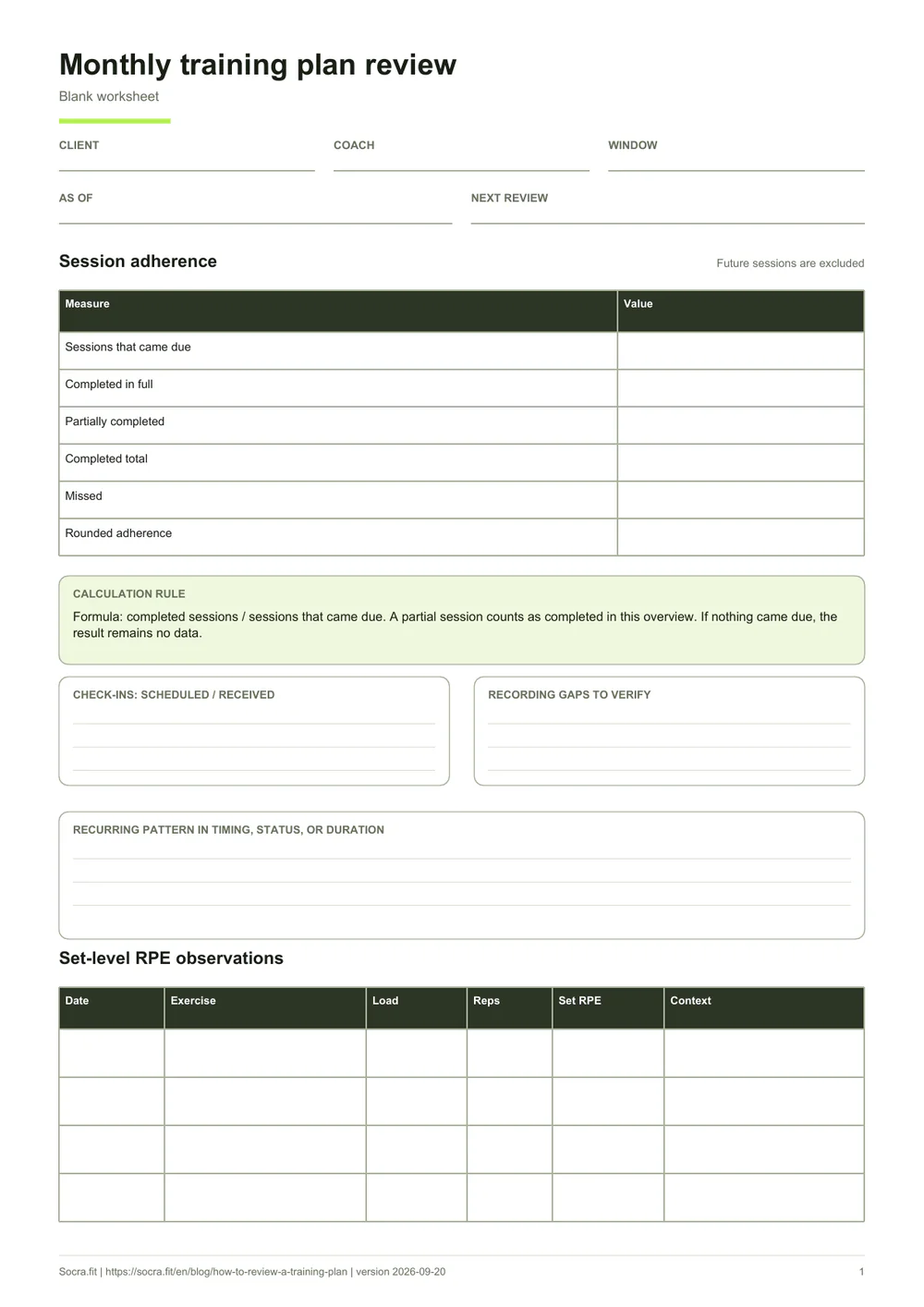
A worksheet for the monthly review
Three printable pages bring together session adherence, check-ins, RPE, and the next agreed action.
Download the PDF worksheet1. Define the review window first
Write down the first and last day of the review period and the date on which you are reviewing it. The denominator includes only prescribed sessions that came due within that window. A future session is not missed or incomplete. It is simply not due yet.
Use this calculation for session adherence:
sessions completed / sessions that came due
In Socra.fit and these templates, completed and partially completed sessions both count as done. A missed session belongs in the denominator but not the numerator. If no session came due during the window, the result is no data. It is neither zero nor perfect adherence.
Also separate a missed session from a recording gap. A missed status asserts that a prescribed session came due and was not completed. An empty older record may mean that nobody recorded the outcome. Verify what happened before you classify it.
2. Pool the whole period before calculating
Add all completed sessions and all due sessions across the window, then divide. Do not average weekly percentages. An average of weekly rates can produce the wrong result when weeks contain different numbers of scheduled sessions.
Use the personal trainer client tracker for repeated reviews. If the plan is still being built, start with the personal training plan template so dates, statuses, and notes follow one structure.
3. Read the individual statuses next
The combined rate tells you how much of the prescribed work was completed. It does not explain two missed sessions or one partial session.
Ask three questions about each exception:
- Was the problem the schedule, session length, equipment, effort, or the record itself?
- Does the same pattern recur on the same day or in the same situation?
- Does the client's comment support that explanation?
A partial session may be a sensible shortened option. It could also show that the plan was too long or that something needs follow-up. The status alone cannot decide which explanation is correct.
4. Use RPE as effort context
RPE describes perceived exertion. In a review, it can show whether reported effort matched the intended effort, but it is not a diagnosis of fatigue or an automatic instruction to change load.
The original study by Foster and colleagues supported session RPE as a way to quantify effort across different training modes. The resistance-training study by Zourdos and colleagues found a relationship between repetitions-in-reserve RPE and bar velocity. Both support subjective effort as a useful input. Neither supports reading it without the rest of the training record.
Look for:
- repeated differences between prescribed and reported RPE
- whether the difference occurs in one exercise or across the session
- whether the client uses the scale consistently
- simultaneous changes in repetitions, load, technique, or available time
A fictional set-level example
These four records belong to the fictional Alex example below. They are RPE values for one set, not session RPE for the entire workout.
| Date | Exercise | Load | Repetitions | Set RPE |
|---|---|---|---|---|
| Aug 24 | goblet squat | 20 kg | 10 | 7 |
| Aug 31 | goblet squat | 22 kg | 10 | 8 |
| Sep 7 | goblet squat | 22 kg | 10 | 9 |
| Sep 14 | goblet squat | 22 kg | 10 | 8 |
The same 22 kg for the same repetitions produced different reported effort across three weeks. That does not automatically mean the coach should add or remove load. Compare technique, other sets, the client's comment, and the circumstances of each week. A qualified trainer can then judge whether the pattern reflects ordinary variation, a need to calibrate RPE, or a reason to modify the plan.
For a client-facing explanation of RPE and RIR, use the 1RM and RPE calculator.
5. Keep check-in coverage separate
A check-in tells you whether the coach received the agreed context. It does not tell you whether prescribed sessions were completed. Never add check-ins to the session count or combine both into one score.
Keep two separate statements:
- The client completed 10 of 12 sessions that came due.
- The client sent 3 of 4 scheduled check-ins.
A missing check-in should first prompt a question. The timing, length, or delivery method may be the problem. You can create a consistent process with the online coaching check-in form.
Fictional example: Alex's monthly review
Alex is a fictional adult general-fitness client. The plan contains three sessions per week on Monday, Wednesday, and Friday. The review window runs from August 24 through September 20, 2026, inclusive, and the review takes place on September 20.
| Week of | Monday | Wednesday | Friday |
|---|---|---|---|
| Aug 24 | completed | missed | completed |
| Aug 31 | completed | partial | completed |
| Sep 7 | completed | missed | completed |
| Sep 14 | completed | completed | completed |
Twelve sessions came due by September 20. Ten count as completed, including one partial session, and two were missed. The rounded session adherence is 83 percent. A pending session on Monday, September 21 is in the future and is excluded.
Scheduled check-ins were August 30, September 6, September 13, and September 20. Alex sent the first, second, and fourth. Check-in coverage is 3 of 4 and remains separate from session adherence.
What the example supports
- Alex completed most sessions that came due.
- Both missed sessions occurred on Wednesday, so the Wednesday time and duration deserve a question.
- The partial session also occurred on Wednesday. That strengthens the scheduling question but does not establish the cause.
- One check-in is missing. We do not know whether Alex forgot, had nothing to add, or disliked the timing.
What the example does not support
- It does not show a change in Alex's fitness, strength, or body measurements.
- It does not prove that Wednesday sessions are too difficult.
- It does not determine whether volume should increase, decrease, or stay the same.
- It does not explain why the check-in was missing.
A sensible next action is a short conversation: "All three training exceptions occurred on Wednesday. What happened on those days, and was the issue time, duration, effort, or something else?" The answer may support a schedule change, a shorter option, or another modification that a qualified trainer considers in full context.
Decisions after the review
Work through the relevant branches below. More than one may apply in the same review.
The plan is working and practical. Keep the structure and agree on what to observe next. A review date does not require a plan change.
The plan is appropriate but does not fit the week. Adjust timing, duration, or the backup option. Remove a specific source of friction instead of treating a lower number as a failure.
Reported effort does not match the intent. Verify the RPE definition, technique, and records. A qualified trainer can then decide whether a programming change is appropriate.
The data conflicts or is incomplete. Do not guess. Improve the recording process and use a shorter follow-up window.
The client reports something outside your scope. Pause the relevant decision and refer to an appropriate qualified professional. A monthly review is not a medical assessment.
A monthly client summary you can copy
Copy and adapt
Hi, I reviewed the period from [date] to [date]. Of [number] sessions that came due, you completed [number] in full, completed [number] partially, and missed [number]. Combined, [number] of [number] due sessions count as completed. I excluded future sessions.
I noticed this pattern: [one specific observation]. Before I change the plan, I need to ask: [one or two questions].
For the next period we agree on this action: [specific change or decision to keep the plan]. We will watch: [one to three inputs]. The next review is [date].
Only fill in what the record supports. "Wednesday repeatedly fell away" is an observation. "You lack motivation" is an interpretation that the client must first confirm.
Review checklist
- Is the review period explicit?
- Are future sessions excluded?
- Did you pool session counts across the entire period?
- Did you separate a missed session from a missing record?
- Is session adherence separate from check-in coverage?
- Is RPE interpreted with performance, technique, and comments?
- Did you ask a question before assigning a cause?
- Is there one concrete next action and a date for the next review?
Use the client tracker for an ongoing overview across clients. The purpose of the review is not to grade the client. It turns records into a decision the client can understand.